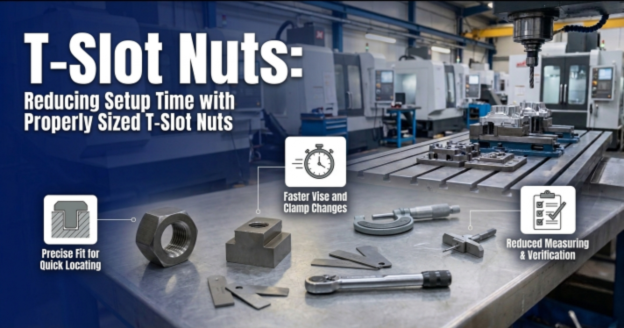
Reducing Setup Time with Properly Sized T-Slot Nuts
Setup time has a way of disappearing before you ever make a cut, and more often than not, it’s the hardware’s fault, not the operator’s. A T-slot nut earns its name honestly: it’s shaped like a T and built to slide into the channel of a machine tool table for work holding during machining, with a stud usually threaded into the top to lock the workpiece in place.
Size it right for the slot, and clamping is fast and solid. Size it wrong, and you’re wrestling the fixture instead of running the job. That’s the reason most shops don’t gamble on hardware and stick with a dependable T-Slot Nuts Manufacturer instead.
Why Sizing Is the Whole Game
A T-slot nut only works as well as it fits inside the channel. Too loose, and the nut can shift under load, throwing off alignment right when you need the workpiece to stay put. Too tight, and you are fighting to slide it into position, wasting minutes on something that should take seconds. The neck size, the bottom width, and the step height all have to match the slot on the table, not just approximately but precisely. When a shop standardizes on correctly toleranced nuts, that fitting problem disappears, and clamping becomes a matter of dropping it in, threading the stud, torque it down.
The Nut and Stud Working Together
What makes this setup effective is how simply it comes together. A stud, typically a double-ended steel stud, threads into the top of the T-slot nut once it is seated in the table channel, and that connection is what actually secures the workpiece being machined to the table. There is not much to it mechanically, which is part of the appeal. A properly sized T-Slot Nuts Manufacturer builds the nut so it seats cleanly in the slot and threads consistently with the stud every time, without the operator having to compensate for a bad fit.
Material and Hardening Matter Too
These nuts are machined from cold-finished steel bar stock rather than cast or stamped, which gives them a cleaner, more dimensionally accurate starting point. On top of that, they are case-hardened, so the surface holds up against the repeated wear that comes from sliding in and out of table channels, tightening and loosening studs, and generally getting used far more often than most shop hardware. A nut that wears out of spec after a few dozen uses ends up costing more time in the long run than it saved on day one, so the hardening step is not just a nice touch; it is what keeps the fit consistent over years of use.
Read Also: How Nuts T Slot Hardware Supports Safer and More Consistent Machining Operations
Fewer Interruptions, Faster Changeovers
Setup time adds up fastest during changeovers, when a shop is swapping fixtures or repositioning parts between jobs. If every T-slot nut on hand fits its slot correctly and threads cleanly onto a stud, changeover becomes a repeatable routine instead of a scavenger hunt through a parts bin looking for the one nut that actually seats right. Standardizing hardware across a shop, rather than mixing sizes from different sources, is one of the simplest ways to shave real minutes off every single setup, and those minutes compound fast across a week of production.
Inch and Metric, Covered Either Way
Shops working across different equipment standards do not want to be stuck sourcing two separate lines of hardware. These T-slot nuts are available in English inch sizes as well as metric sizes, with other sizes available on request for less common configurations. That kind of flexibility matters when a shop runs a mix of older domestic machines alongside newer metric equipment, since it means one supplier can cover both without forcing a compromise on fit.
Where to Source It
Getting this right consistently comes down to who is making the part. George H. Seltzer & Co., through its ZIP line of workholding hardware, machines T-slot nuts from cold-finished steel bar stock and case-hardens them for strength, built specifically for use with ZIP Studs. Working with an established name rather than an unknown reseller tends to mean fewer surprises when a part shows up out of tolerance.
Conclusion
Setup time is one of those costs that rarely gets scrutinized closely, but it adds up fast when the hardware holding a job down does not fit the way it should. Properly sized T-Slot Nuts, machined accurately and case hardened for durability, turn clamping into a quick, repeatable step instead of a recurring headache. Pair the right nut with the right stud and the right slot, and a shop gets a connection that holds through the whole job, freeing up time for the work that actually matters, cutting metal.
FAQs
It’s a T-shaped nut that slides into the channel of a machine tool table for workholding during machining. A stud is usually screwed into the top of it to secure the workpiece.
A nut that doesn’t fit the slot correctly can shift under load or take extra time to seat. Properly sized nuts make clamping fast and repeatable instead of a fight.
They’re machined from cold-finished steel bar stock rather than cast or stamped. This gives them a cleaner, more dimensionally accurate fit
Yes, they’re case-hardened to hold up against repeated wear from sliding in and out of table channels. This helps them stay within tolerance over years of regular use.
Yes, they’re offered in both English inch sizes and metric sizes. Other sizes are also available on request for less common configurations.