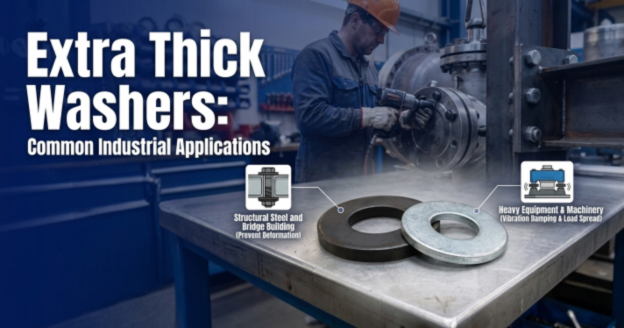
Anyone who has spent real time around a mill or a fixture bench knows a thin stamped washer only gets you so far. Once a clamped joint sees real pressure, that thin disc of steel starts to flatten, dent, or wander out of place, and the whole setup loses its grip. The fix is simple and has been around for a long time: machine the washer from solid 12L14 cold-rolled steel bar instead of stamping it from sheet stock.
Give it chamfered edges and a proper beveled finish, and you get a part that spreads the load of a bolt or nut across more surface without folding under it. That is the whole point of Extra Thick Flat Steel Washers, and it is why fixture builders and machine shops keep them on hand.
What Actually Makes It Different
Every flat washer does the same basic job, spreading out the clamping force so a bolt head or nut does not just dig a crater into whatever it is bolted against. A thicker washer does that job better, plain and simple. More steel behind the bearing face means more resistance to bending and crushing when torque gets cranked down or when the joint takes repeated stress. It is not a fancy engineering trick. It is just mass doing what mass does.
Where Workholding Comes In
This is where the washer earns its keep day to day. Machine shops running T-slot bolts, step blocks, and strap clamps to hold parts down on a mill table lean on extra-thick washers as part of that same clamping system. When you are torquing down a strap clamp or T-slot bolt over a workpiece, a thicker washer keeps that clamping pressure spread evenly instead of letting it dig into the table surface or the fixture itself. That is why you will often see Extra Thick Flat Steel Washers sitting right next to T-slot nuts, coupling nuts, and set-up wedges in a shop’s hardware drawer. They belong to the same family of tools.
The Inside Diameter Actually Matters
Fit is not an afterthought here. These washers are machined so the inside diameter runs 1/64 to 1/32 inch over the bolt size they are paired with. That is tight enough to keep the washer sitting snug against the fastener shank, without so much play that it can shift once torque is applied. It sounds like a small detail until you have watched a loose-fitting washer slide sideways mid-clamp and throw off an entire setup.
Read Also: T-Slot Nuts: Why They Are Still Important in Machine Tool Setups?
Case Hardening, If You Need It
Not every application calls for it, but case hardening is available on these washers for a small additional charge. If a washer is going to be reused constantly across job after job, that hardened surface holds up better against wear, denting, and general abuse. It is a nice option to have rather than a requirement, and it lets a shop dial in exactly how much durability a given job actually needs instead of over-specifying every part.
Inch and Metric, Side by Side
Not every shop or supplier works in the same units, so these washers come in both English-inch sizes and metric sizes. On the inch side, they run from a 3/16-inch bolt diameter (#10) all the way up to 1-1/4 inches, with outside diameters and thicknesses scaled accordingly at each step. Having both standards available under one line saves a supplier from having to juggle two different vendors just because a project switches specifications halfway through.
Sourcing It from the Right Place
None of these matters much if the washer coming off the shelf does not actually hold to spec. Tolerances, edge finish, steel grade, all of it needs to be consistent, and that only happens when you are buying from a supplier who actually machines these parts correctly rather than cutting corners. George H. Seltzer & Co., known in the trade through its ZIP line of workholding hardware, has been producing extra-thick flat steel washers in both inch and metric sizes, with case hardening available when needed. For anyone comparing options, working with an established Extra Thick Flat Steel Washers Company like this one takes a lot of the guesswork out of sourcing.
Conclusion
There is nothing flashy about a thick steel washer, and that is sort of the point. It does one job, distributing load under a fastener, and it does that job better than a thin stamped part ever could. Machined from 12L14 bar stock, held to a tight inside diameter, chamfered and beveled at the edges, and available hardened if the application calls for it, this is hardware built for shops that actually put their fixturing through repeated hard use. Whether the spec sheet calls for inch or metric, sourcing from a supplier that has been machining this kind of hardware for years, rather than a generic catalog reseller, tends to be the difference between a joint that holds and one that does not.
FAQs
They’re machined from 12L14 cold-rolled steel bar rather than stamped from sheet stock. This gives them more mass and rigidity than a standard flat washer.
The inside diameter runs 1/64 to 1/32 inch over the size of the bolt they’re paired with. That keeps the washer snug on the fastener without excess play.
Yes, case hardening is available for a small additional charge. It’s a good option for washers that get reused repeatedly across jobs.
Yes, they’re offered in both English inch sizes and metric sizes. Inch sizes range from a 3/16 inch (#10) bolt diameter up to 1-1/4 inches.
They’re commonly used in machine workholding and fixturing setups alongside T-slot bolts and strap clamps. The added thickness helps keep clamping pressure evenly distributed under load.