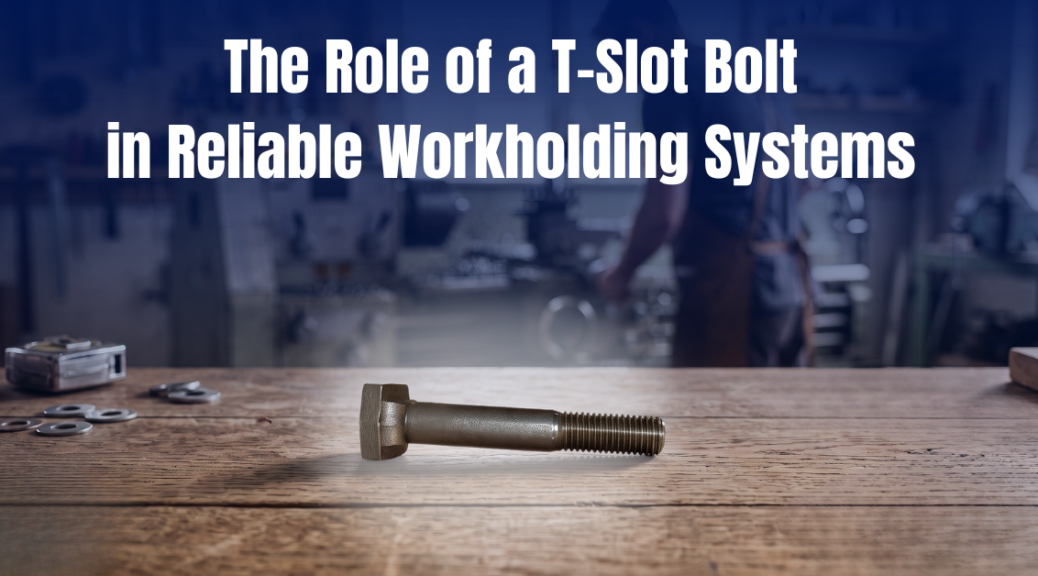
Secure workholding is critical to every machining operation, and one thing that is often taken for granted until something goes wrong. If the workpiece moves during cutting, drilling, or milling, even the most sophisticated machines will not produce accurate results. Incorrect clamping can result in dimensional errors, tool damage, wasted material and costly downtime. For manufacturers striving for better precision and consistency, reliable workholding is a must. That’s important.
One of the simplest, but most critical components in a successful workholding setup is the T-Slot Bolt. This fastening element is used for a secure connection between clamping devices and machine tables, guaranteeing stability under heavy loads and repetitive operations.
Working with a T-Slot Bolt
The T-Slot Bolt is a special type of fastener that fits into the T-shaped slots on machine tables, fixture plates, and workbenches. The unique head locks securely in the slot so that clamps and fixtures can be tightened without slipping or rotating.
This design offers a stable base for holding workpieces for machining but allows for quick and efficient fixture adjustments.
Why is Reliable Workholding Important?
Good workholding influences every step in the manufacturing process. Even a slight movement of the workpiece can affect the quality of the product and the efficiency of production.
Dependable workholding helps by:
- Dimensional accuracy retention
- Vibration reduction in machining
- Keeping the workpiece from moving
- Better surface finish
- More safety for the operator
- Tool life prolongation
- Cut down material waste
With every part safely in place, machining becomes more predictable and productive.
How a T-Slot Bolt Provides a Secure Clamp?
The main function of a T-Slot Bolt is to provide a secure anchoring point for clamping systems. It is not only a bolt. It is made to work on the T – slot tables of many kinds of industrial equipment.
The design has several advantages:
- Secures fixtures even in high cutting forces
- Evenly distributes clamping pressure
- Stops the bolt from turning when you are torquing it.
- Allows repositioning without damage to the machine table
- Supports setups for temporary and permanent fixtures
These features make it an important component in precision machining.
Applications in Various Industries
As workholding is important to many manufacturing environments, a T-Slot Bolt is widely used in various industries.
Common applications are:
- Machining Centers – CNC
- Milling Machine
- Drilling machines
- Grinding machine
- Tool-room
- Fittings making
- Metal Fabrication Plants
- Assembly benches for industry
It is useful where secure fixture location is needed anywhere because of its flexibility.
Performance Enhancing Features
Not all fastening solutions work as well in industrial conditions. A quality T-Slot Bolt is designed to endure the rigors of demanding production environments.
Key Performance Features Include:
● Construction High Strength
These bolts, made of either tough alloy or high-strength steel, can be repeatedly tightened and can withstand heavy clamping loads.
● Accurate Dimensions
Correct size for proper fit in machine table slots to prevent movement during machining.
● Corrosion Resistance
Industrial use makes the bolt resistant to rust and wear with protective finishes for the long run.
● Consistent thread quality
Good machine threads will give consistent tightening and less chance of damaging the threads over time.
Selecting the Proper T-Slot Bolt
The right T-Slot Bolt isn’t simply a matter of matching the thread size. The right choice is machine and application dependent.
Here are some things to consider before you buy:
- T-slot size for machine table
- Required thread size
- Bolt length required
- Anticipated clamping force
- Mechanical properties
- Operating environment
- Works with existing clamps and fixtures
The correct specifications are important for better safety and machining precision.
Avoid These Common Mistakes
Many of the problems with workholding are not equipment failure but incorrect installation
Don’t make these common mistakes:
- Bolt size wrong
- Mixing dissimilar clamping components
- Unequal clamping pressure
- Ignoring frayed threads
- Repeated use of damaged bolts
- Not checking fixtures before machining
Improving the reliability of the equipment and the quality of machining can avoid these problems.
Why Quality Components Are Important?
The workholding system is only as good as its individual parts. A good T-Slot Bolt is an investment that pays for itself in reduced chances for unexpected movement, improved machining precision, and more consistent production results.
It’s a relatively small component, but its contribution to operational stability is substantial. “When operators have reliable fastening, they can focus on productivity instead of correcting avoidable setup problems.
Final thoughts
Reliable workholding starts with reliable components that hold every setup secure throughout the machining process. Selecting the appropriate T-Slot Bolt can enhance machining precision, promote safer operations, and uphold consistent production quality in diverse industrial applications.
At George H. Seltzer & Co., we know that quality hardware is the backbone of dependable workholding. Our T-Slot Bolt solutions are built to be durable, strong, and precise to ensure long-term performance in demanding machining environments. We are here to help you select the right fastening components for strong workholding systems. Get in touch with us today to find the right T-Slot Bolt for your manufacturing needs.
FAQs
A T-Slot Bolt is used to secure clamps and fixtures to machine tables, ensuring stable and accurate workholding during machining operations.
It prevents workpiece movement, helping improve machining precision, safety, and overall production efficiency.
They are commonly used with milling machines, CNC machines, drilling machines, grinding machines, and fixture tables.
Select one based on the machine’s T-slot size, thread specifications, required length, and expected clamping load.
Most are manufactured from high-strength steel or alloy steel to withstand heavy industrial use.