Industrial machinery is designed to withstand pressure, vibration, heavy loads, and continuous operation. But a lot of equipment failures don’t start with the big stuff. They usually originate at fastening points where stress concentration increases over time. A loose connection, a damaged surface, or an uneven distribution of load can reduce the performance of the machine over time and lead to costly repairs.
This is where fastening accessories are far more important than they seem. Extra-thick flat washers are the preferred choice in manufacturing facilities, machine shops, fabrication plants, and heavy industrial environments. They are supposed to give more support than regular washers, to help spread the loads and to protect the surfaces to which they are attached from damage.
How To Find Extra-Thick Flat Washers?
On the surface, a washer can seem like a very simple part. The washer thickness does, however, directly influence how the forces are distributed in the bolted joint.
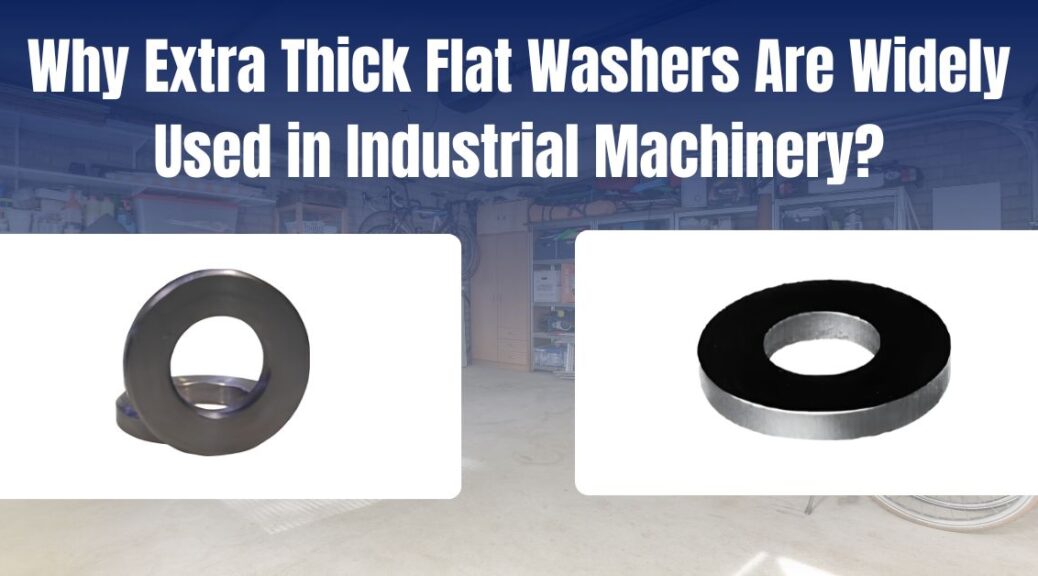
Extra-thick flat washers are made thicker than standard washers, enabling them to support greater weights and provide stronger support under nuts and bolt heads. They are intended to decrease local stress and increase the general stability of the fastening system.
Improved Weight Distribution
Another reason why manufacturers favour extra-thick flat washers is their ability to spread loads over a larger surface area.
Lack of support can lead to high clamping forces in small areas, which can increase the risk of:
- Surface deformation
- Damage to property
- Lower clamping force
- Early wear
They help to distribute the load evenly and keep the fastener and the materials being fastened together. This leads to a more stable and reliable set-up.
Higher Resistance To Compression
Frequently, industrial equipment is subjected to high clamping forces. Regular washers can sometimes get deformed under great pressure and become inefficient over time.
Extra-thick flat washers are more resistant to compression, so they are able to maintain their shape even in extreme operating conditions.
That extra durability supports:
- Consistent clamping pressure
- Increased joint stability
- Longer life
- Fewer maintenance requirements
It is important to have the integrity of the fasteners when you are dealing with machinery that runs 24/7.
Better Performance In High-Vibration Environments
Vibration is a common problem in industrial machines. Equipment such as presses, milling machines, conveyors, and automated production systems can slowly influence the performance of fasteners, thereby creating continuous motion.
Extra-thick flat washers provide a stronger bearing surface under the fastener, which helps support more stable fastening assemblies.
Washers do not prevent loosening on their own, but can be important in creating a more secure connection that will hold better under demanding operating conditions.
Suitable For Heavy Duty Machinery Applications
In many industrial applications, fastening systems must be able to support high loads.
Common uses are:
- Mounts for machine tools
- Workholding fixtures
- Machinery for manufacturing
- Construction equipment
- Material handling systems.
- Industrial manufacturing machinery
Extra-thick flat washers are often chosen for projects where standard washers may not offer sufficient support due to their strength and reliability.
Extended Equipment Life
Every part of a machine plays a role in its longevity. If the fastening systems don’t hold, this movement can increase wear on surrounding parts.
Washers play an important role in prolonging the life of equipment. Washers help in maintaining tight connections and reducing stress concentration.
A good fastening system can help:
- Reduced wear on components
- Minimize downtime
- Improve operational reliability
- Lower maintenance costs
These benefits make washers a small investment with a large impact on long-term performance.
The Importance Of Product Quality
Not all washers are made to the same standard. Performance can vary due to differences in material quality, dimensional accuracy, and manufacturing processes.
That is why many industrial buyers prefer to source products from an experienced Extra-thick washers company that understands the demands of industrial applications.
A good Extra-thick washers company will typically focus on:
- Dependable quality
- Accurate measurements
- Selecting trusted materials
- Consistent product performance
- Standard Specifications for Industrial
The use of quality components is important to ensure that the fastening systems work as they are designed to do for their whole life.
How To Choose The Right Washer For Industrial Equipment?
Before selecting washers for an application, it is very important to evaluate the operating conditions.
The major considerations are:
- Load requirements
- Compatibility with fastener size
- Specifications of material
- Environment conditions
- Exposure to vibration
- Surface protection requirements
Proper washer selection contributes to the reliability of the fastener and performance of the equipment.
Summary:
Industrial machinery needs secure and strong fastening systems to work properly. Extra-thick flat washers provide the additional strength, load distribution, and surface protection required for high-demanding industrial applications. They can increase the stability of the fastening, making them a valuable part in many different machines and equipment.
At George H. Seltzer, we understand the critical role that fastening performance plays in industrial operations. We help customers find reliable solutions, for example, extra-thick flat washers, to achieve equipment reliability and long-term productivity.
Give us a call today to talk about an Extra-thick washers company and the washer solutions that best fit your industrial needs!
FAQs
Extra-thick flat washers are heavy-duty washers designed with greater thickness to provide improved load distribution and fastening support.
They help distribute clamping forces, reduce surface damage, and improve the stability of fastening assemblies.
They maintain stronger fastening connections and help reduce wear caused by uneven pressure distribution.
Yes, they are specifically designed for applications that require higher load-bearing capacity than standard washers.
Yes, they support fastening reliability, which can reduce component wear and maintenance requirements.
They are widely used in machine tools, fabrication equipment, industrial machinery, and work holding systems.
A specialized company typically offers consistent quality, accurate dimensions, and products designed for industrial applications.